Wednesday, 29 March 2017

Programme Summary


Semiotics

Post-Modernism - Part 1


Modernity & Modernism


Colour Theory: Subjective Colour

Systematic Colour Part 2 - The Principles of Colour


Colour Theory: Systematic Colour - Part 1

What Is Research?

Digital Production & Distribution


Tuesday, 28 March 2017

Study Task 5: Andy Warhol at the Whitworth

Whitworth Art Gallery - Manchester 

I went to gather some primary research in order to validate my investigation and aid the progression of my project further. The idea was to see how people responded to the art in this formal environment, and how the walls of the gallery, and pressure of people around, changes the habits as well as the types, of people visiting. 

The gallery is a really gorgeous space, and unlike most, as there weren't people on look out in every room, it felt much more relaxed and free roam. The rooms that did however, were tenser, and I found myself reluctant to take pictures despite that being allowed.

The cameo prints below, are extremely popular in current day high street fashion trends. Here we see ways where fashion and high art can interconnect in populist ways - presenting a forum that could be used interchangeably - e.g. using the Gagosian rebrand to promote fashion prints and styles in some way. 


The contrasting large white walls again the viewer is overpowering and belittling. People tend to stand a meter or so away from the piece, often pondering to themselves - due to arts intrusive nature. It is important to understand the human activity / body language / character traits within the gallery space, in order to see how to break through these barriers. For example, if the walls were brightly coloured, or the rooms were more busy and had less empty space - more art in one room, or even less quiet - played music in the background - given headphones and a music player device, then a more colloquial setting would occur. 

In terms of a wayfinding system, the viewer could even be invited to view the piece from different locations around the room, possibly by marked circles on the floor, in order to create a greater understanding or appreciation for the work, and thus a looser relationship with the space, as it would have been explored. 


The idea of repeating populist signs with different bright colours is an interesting style that definitely links to the tackiness associated with popular culture and design. The $ (dollar) sign, for example, is a clear example of how Warhol used these everyday symbols to break the barriers of the high art and commercial world, ultimately mocking it in the most ironic sense. 


I then found in the gift shop this colouring book, which I found particularly relevant to the idea of lowering the statute of acknowledgment for high art through the commercialisation of it into consumerist goods. The colouring book that was aimed at young children epitomises the idea that his work has been belittled to nothing less than a money making scheme - if this is the direction of art, then it is highly relevant for these institutions to shout to a wider market. If they are willing to sell products as such in their shops, they are obviously open to the commercialisation of the art itself. 

Existing Branding

Art Gallery Branding

Conclusions:
consider - supergraphics, posters, books/ magazines, advertising, leaflets, signage, websites 

1) 'Collect' by Spin - UK


Collect is an international art fair that took place at London’s Saatchi Gallery. Presented by the Crafts Council, Collect gave visitors the chance to see and buy museum-quality and contemporary ceramics, glass, jewellery, wood, metal and textiles created by established and emerging artists and makers represented by over thirty of the world’s best galleries.
Collect’s brand identity, designed by Spin, draws character, play and visual interest from an economical use of a single and fairly austere font, and a black and white colour palette, and went on to include a variety of print communications including leaflets and catalogue, art direction, animation, advertising, signage and environmental graphics.
Collect successfully combines type and image to enable an identity that can be used in multiple forums. The idea of the slanting l, which is able to stand alone in the first poster, enables consistency throughout the branding that can be utilised within many forums. 
2) 'In Search Of The Present' by Werklig at EMMA, Finland
In Search Of The Present is a new series of exhibitions on a 3–4 year cycle held at Helsinki’s Espoo Museum of Modern Art (EMMA). These intend to tackle many of the existential questions that we face in an ever changing world. The first exhibition, inspired by Olavi Paavolainen’s essay collection from 1929, was a study in the representations and expressions of human identity in the digitalised world.
Drawing on the themes of change and the passage of time, Finnish graphic design studio Werklig developed a brand identity connected by a sense of movement, implied in the cropping of text across posters, books, and supergraphics, physically in the motion of outdoor campaign posters, and digitally in the scrolling of social media content.
Using supergraphics could be a strong way to transpire a bold and clear message and identity for the gallery. Especially as Gagosian has multiple locations, a recurring bold signage or wayfinding system that is consistent throughout each location, could become a populist identity that is know therefore, around the world. 
3) 'Gallery & Co.' by Foreign Policy, Singapore 
& Co. links museum shop, a food and drink retailer and cafe housed within the National Gallery Singapore. These share a brand identity designed by Singapore-based graphic design studio Foreign Policy, built around the basic foundations of modern art and design; primary colour, geometric form and repetition, and Grilli Type’s GT Pressura. This runs across and unites a variety of printed materials that includes, but is not limited to, vouchers, packaging, uniforms and posters. 
The use of bold, san-serif clean type, is combination with geometric shapes definitely appeals to a wider audience. The idea of a pattern or print that can be widely recognised alone, and in combination with text could be useful for appealing to those academic and those more visual
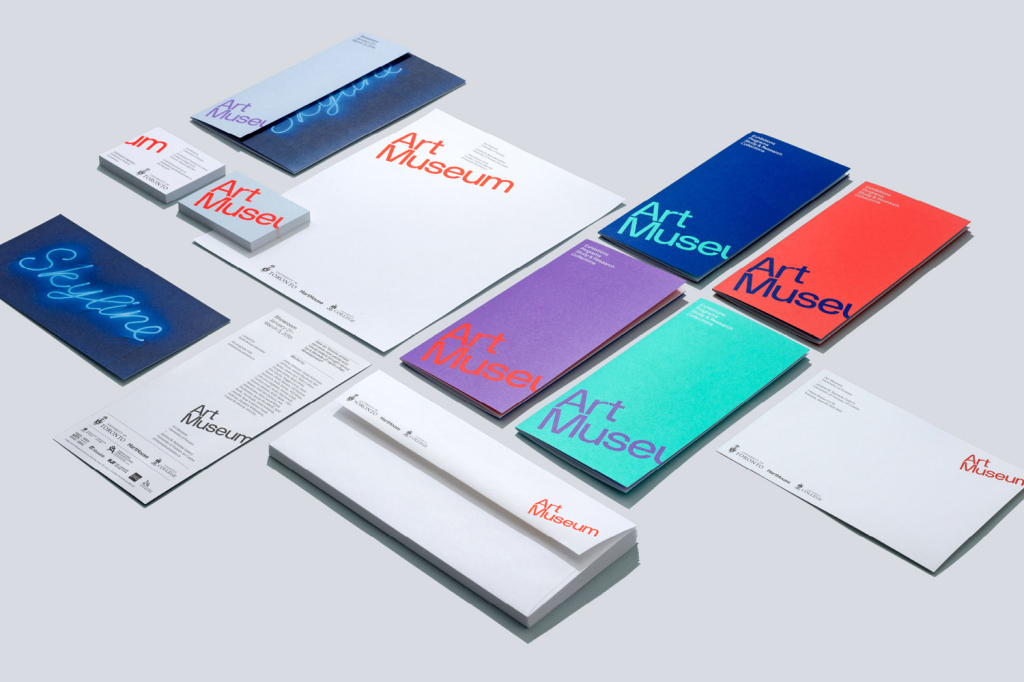
4) 'Art Museum' by Underline Studio, Canada 
Art Museum unites the Justina M. Barnicke Gallery and the University of Toronto Art Centre as one new institution dedicated to exhibition and education. It is one of the largest gallery spaces for the visual arts in Toronto and is housed within an iconic gothic-style building.
The museum worked with Canadian graphic design studio Underline to develop a new brand identity system that would emphasise its placement within the city, and engage both the university community and the Toronto public. This extends across a variety of print communications including brochures, programs, posters, signage and website.
Here we see an attempt to attract a variety of ages - the university and the general public - as such this is an important reference to look at techniques and styles they used to atract a broader target audience. The bright colours and clarity definitely combine to aid the success of this branding. 


05 - Research: How To Attract Crowds

CREATING GAMES - interactiveness - entertainment - all inclusive

http://www.independent.co.uk/voices/comment/the-two-universal-truths-of-visiting-art-galleries-as-proved-by-one-simple-game-10213338.html

Relevant points to consider highlighted in red 

Dulwich Picture Gallery usually gets about 500 visitors a week. Which is not great, considering that it is a gorgeous gallery in the capital and is filled with masterpieces. So we must salute the chutzpah of its curator, Xavier Bray, who has boosted attendance enormously by inventing a game, namely slotting in a fake along the permanent collection of true Old Masters, and asking people to guess which one it was. The public loved the challenge. Thousands turned up to play Bray’s game. “Never before have I seen so many people actively looking at each painting,” he observed. “You could see them looking at every single picture, trying to work out the brush marks.”


Art needs to be entertaining. Giving visitors some sort of activity – over and above that of standing in front of a picture nodding gently – is bound to work, because people love a challenge. It’s the same reason why children are given clipboards and quizzes when they visit the Foundling Museum, or Tate Liverpool. It’s why the British Museum hands out backpacks full of quests and quizzes to young visitors. Having a task to do actually makes you start looking. I have seen all sorts of weird stuff at the BM which I never would have experienced, thanks to tagging along with my kids and helping them find dragons or monsters.  

Of course galleries should be places for scholarship and silent wonder, but they also need to be a place for games, and fun, and challenges – and not just for the under 12s. Tate Modern has (sometimes) been criticised for putting entertainment over and above the silent contemplation of modern art, but again, this is shortsighted. People often don’t realise that the permanent collection of what is now the world’s most popular modern art gallery is actually the same collection which resided at the old Tate (now Tate Britain). Only once it was put in a funky new building, and surrounded by exciting, easily understandable and witty things such as giant spiders, huge slides or a sunburst, it gained a whole new character and, literally, millions of new fans. It became part of a fun day out, not a grim chore imposed by worthy parents or schools.

It is important to note that this rebranding will sacrifice the more respectable sides of high art institutions - that of self reflection - however will redefine art as a way of life for everyone, and utilise these free institutions to enhance quality of life and entertainment to a greater expanse of the public 

Most Visited Galleries

Palace MuseumChina Beijing16,000,0002016[2]
LouvreFrance Paris7,300,0002016[3]
British MuseumUnited Kingdom London6,820,0002015[4]
Metropolitan Museum of ArtUnited States New York City6,700,0002016[5]
National Palace MuseumTaiwan Taipei6,142,892
2016[6]
Vatican MuseumsVatican City Vatican City6,002,2512015[7]
National GalleryUnited Kingdom London5,900,0002015[8]
Tate ModernUnited Kingdom London4,700,0002015[9]
National Gallery of ArtUnited States Washington, D.C.4,104,3312015[10]
State Hermitage MuseumRussia Saint Petersburg3,668,0312015[11]
Reina SofíaSpain Madrid3,646,5982016[12]
Victoria and Albert MuseumUnited Kingdom London3,460,5002016[13]
Musée d'OrsayFrance Paris3,440,0002015[14]
Musée National d'Art ModerneFrance Paris3,335,5092016[15]
Somerset HouseUnited Kingdom London3,235,1042015[16]
Museum of Modern ArtUnited States New York City3,066,3372013[17]
National Museum of KoreaSouth Korea Seoul3,052,8232013[17]
At the top of their trade, the art galleries can become worldwide / international attractions, and even build up entire cities. For example the Guggenheim Museum Bilbao, a museum of modern and contemporary art in Spain, was designed by Canadian architect Frank Gehry, and due to its immense beauty, became a landmark attraction and saved the deterioration the the city:
"One of the most admired works of contemporary architecture, the building has been hailed as a "signal moment in the architectural culture", because it represents "one of those rare moments when critics, academics, and the general public were all completely united about something."The museum was the building most frequently named as one of the most important works completed since 1980 in the 2010 World Architecture Survey among architecture experts."

http://www.ft.com/cms/s/0/8ae7d656-73a5-11dc-abf0-0000779fd2ac.html?ft_site=falcon&desktop=true#axzz4ccHaeIeo - The Museum That Saved A City 

The Louvre, Tate and National Gallery all withhold famous pieces of art that have transcended the realms of high art into popular culture society whereby everyone knows of the messages, artists and aesthetics of these pieces regardless of class. Instead, works such as the Mona Lisa or Van Gogh's starry night, are visited on the basis of popularity and reputation rather than the art itself. 

As such, it is important to apply this trend and motives of social activity into my own developments of transforming a high art environment into one that attracts a mass audience. 

These institutions may become so well known due to:

- Age - historic building are well known due to their prolonged existence 
- TV and Film referencing either the institution of a famous piece of art itself - e.g. mona lisa and stealing it is often referenced in some action films 
- Artist figures - Leonardo Da Vinci and Van Gogh are extremely famous figures themselves and thus it is the celebrity rather than the art that attracts mass culture - e.g. Andy Warhol was a celebrity and so were his subjects thus attracting everyday people who have posters of their favourite celebs in their rooms anyway